The cash machine was born in Enfield, and it ran on "radioactive cheques"
On 27 June 1967 a sitcom star took £10 out of a wall in north London. The machine that paid him used special cheques that, its inventor said, were laced with carbon-14. And his wife is why your PIN has four digits.
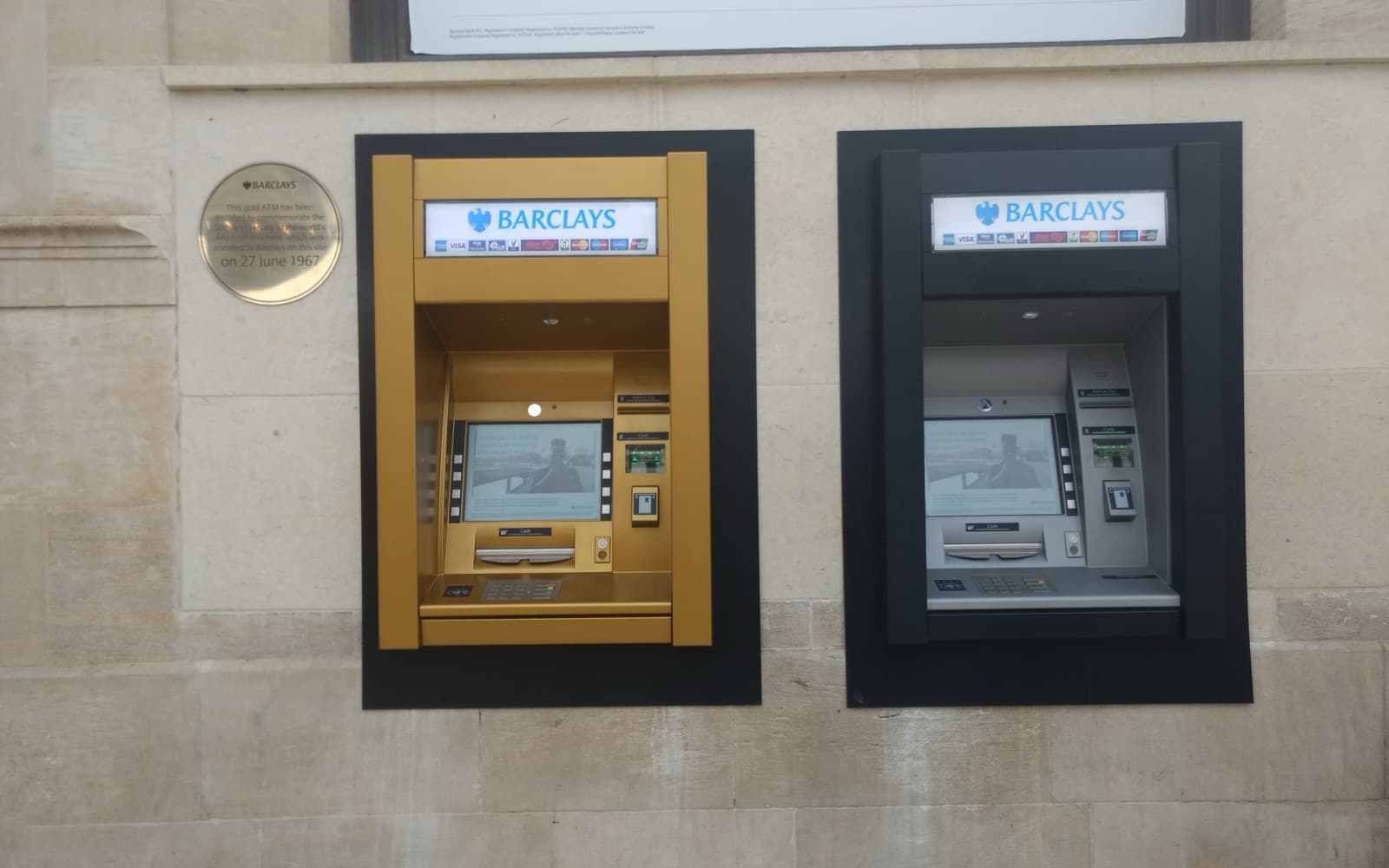
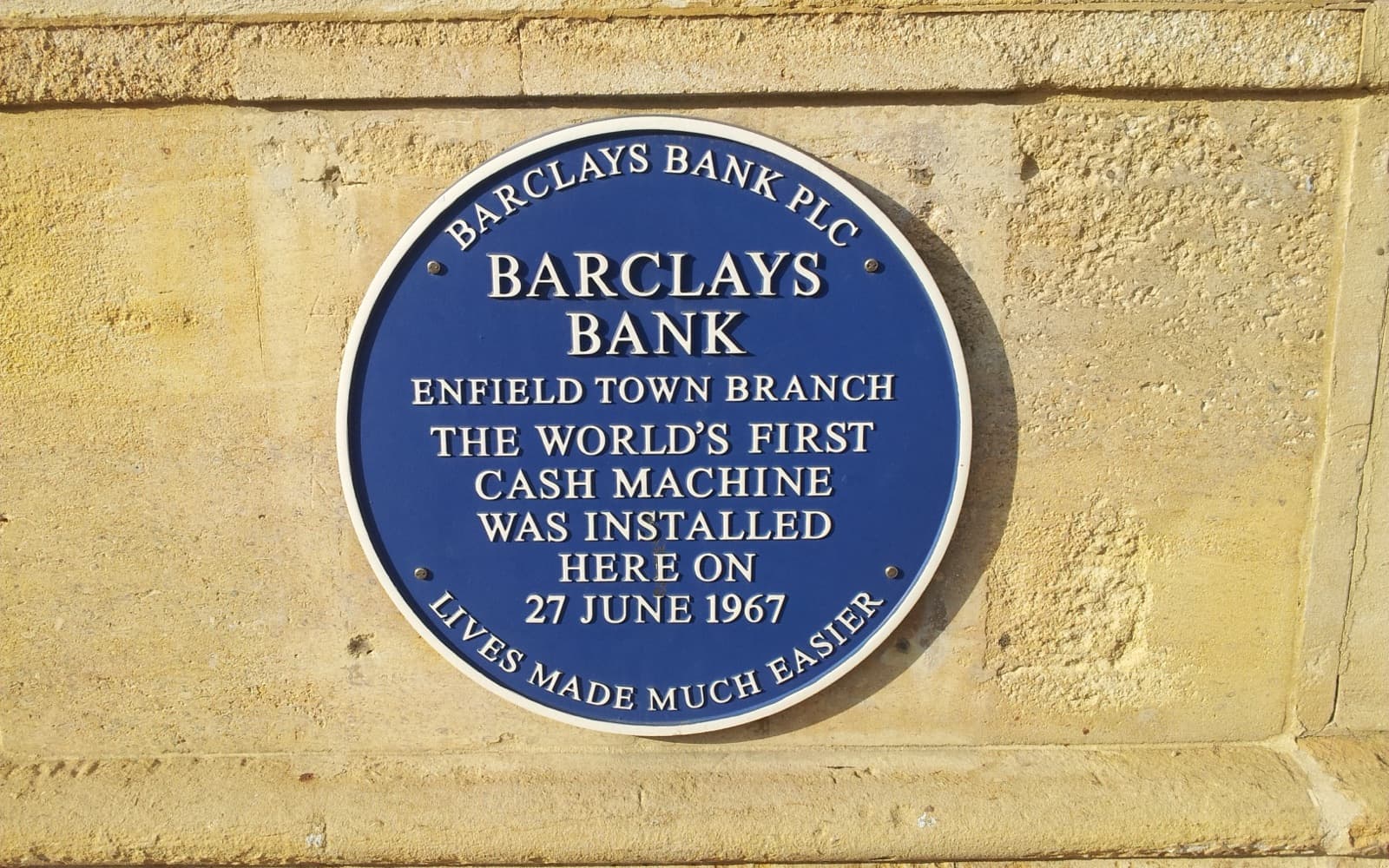
On 27 June 1967, a crowd gathered outside the Barclays bank in Enfield, north London. A curtain was drawn back to reveal a strange new machine set into the wall, and the comedy actor Reg Varney, star of the sitcom The Rag Trade and later famous as bus driver Stan Butler in On the Buses, stepped up to use it. A few moments later he had £10 in his hand.
It was the first cash machine to go into public service anywhere in the world, and it worked very differently from the ones we use today.
A late arrival at the bank
The man behind it was John Shepherd-Barron, who ran De La Rue Instruments, part of De La Rue, the company that printed banknotes. According to his own story, the idea came to him after he reached his bank one Saturday just after it had closed, leaving him without cash for the weekend.
Later, in the bath, he started thinking. "It struck me there must be a way I could get my own money, anywhere in the world or the UK," he told the BBC decades later. "I hit upon the idea of a chocolate bar dispenser, but replacing chocolate with cash."
He took the idea to Barclays, whose chief general manager agreed to try it. Barclays chose Enfield as its test site, describing the town as a "model cross-section community" with a branch that had "a good pavement façade".
Cheques you could not forge
There were no bank cards that could do the job yet. Instead, customers bought special paper vouchers from the bank in advance. To take out money, you put a voucher into a drawer in the machine, typed in a personal number, and a second drawer slid out with £10 in £1 notes. The machine kept the voucher, and the bank processed it like a cheque.
The clever part, according to Shepherd-Barron and Barclays, was that the vouchers were impregnated with carbon-14, a mildly radioactive substance that the machine could detect. He later joked about the safety question: "I later worked out you would have to eat 136,000 such cheques for it to have any effect on you."
De La Rue did not patent the machine. "We wanted to keep carbon-14 secret from potential forgers," Shepherd-Barron told the Guardian in 2005.
The £10 limit sounds small, but £10 went a lot further in 1967. In Shepherd-Barron's words, it "was regarded then as quite enough for a wild weekend".
Why your PIN has four digits
Shepherd-Barron's first plan was a six-digit code, based on his old army number. But when he tried it out on his wife, Caroline, she told him she could only remember four. "So because of her," he said, "four figures became the world standard."
It is a lovely story, and it is his own. The idea of combining a card or token with a secret number had been the subject of a separate patent filed in 1966 by a Scottish engineer, James Goodfellow, who worked at Kelvin Hughes, part of Smiths Industries. Goodfellow's system, with a coded card and a PIN, is much closer to how cash machines work today, and he was appointed OBE for it in 2006.
The two men did not always see eye to eye. "For him to go down in history as the inventor of the ATM really stuck in my throat," Goodfellow told the Guardian. Shepherd-Barron, who was appointed OBE himself, said Goodfellow's invention reminded him of the hovercraft: "an elegant failure".
First, but only just
Enfield's claim to be first is narrower than the plaque suggests. A machine in Sweden went into service in Uppsala just nine days later, and Westminster Bank opened a rival machine, using punched plastic cards, at Victoria in London that July. An American inventor, Luther Simjian, had tried out a machine in a New York bank around 1960, but it only took deposits rather than giving out cash.
Nor was Barclaycash, as the bank called it, an "ATM" in the modern sense. It was a stand-alone cash dispenser, not connected to the bank's computers. Machines that checked your account as you used them came a few years later.
Gold for the anniversary
By the end of that summer, Barclays had installed five more, in towns from Hove to Peterborough. Shepherd-Barron later said he knew it had changed the world when he saw a farmer in Thailand arrive on a bullock cart and take off his hat to use one.
He died in 2010, aged 84. In 2017, for the 50th anniversary, Barclays turned the cash machine in Enfield gold and laid out a red carpet in front of it.
Ironically, Shepherd-Barron also predicted the end of his own invention. In 2007 he forecast "the demise of cash within three to five years". Cash machines are less common than they used to be. But it all started with a hole in the wall in Enfield.
Odd, and entirely British.
More Inventions →