The "missing link" from Sussex that fooled scientists for 40 years
In 1912 a Sussex solicitor unveiled a skull that seemed half man and half ape. It took scientists more than 40 years to prove it was a fake, and over a century to be fairly sure who made it.
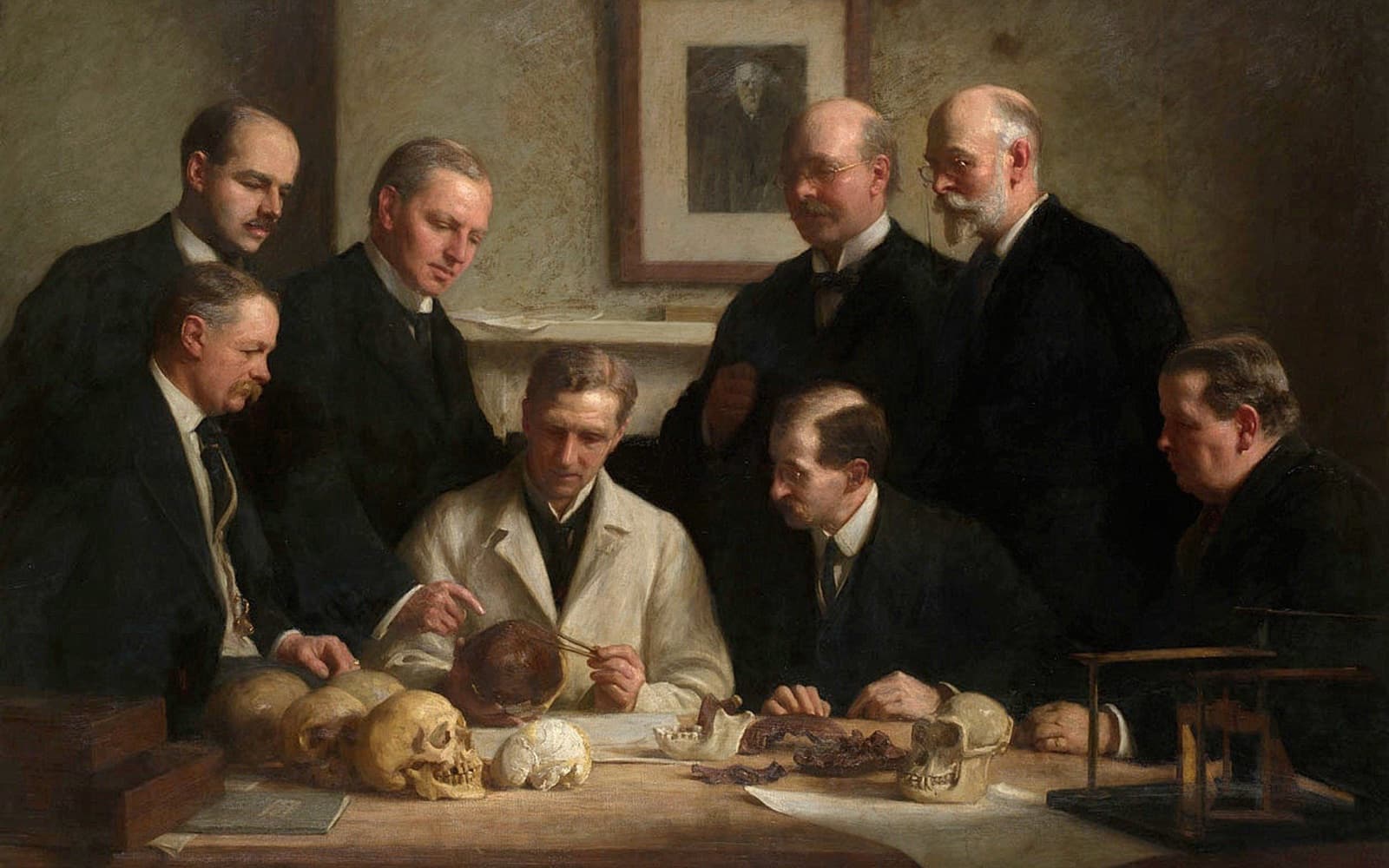
On the evening of 18 December 1912, the meeting room of the Geological Society in London was reportedly as full as it had ever been. Two men stood up to present something extraordinary: pieces of a skull and half a jawbone, dug out of a gravel pit in Sussex. They belonged, the men said, to one of the earliest humans ever found. He would become known as the "earliest Englishman", the title Woodward later gave his book about him.
He was a fake. But it took the scientific world more than 40 years to find out.
The solicitor and the gravel pit
The man behind the find was Charles Dawson, a solicitor from Uckfield in Sussex and a keen amateur collector of fossils and antiquities. He said that a workman digging gravel at Barkham Manor, near the village of Piltdown, had handed him a piece of thick, brown skull a few years earlier. More pieces followed.
In 1912 Dawson wrote to Arthur Smith Woodward, the Keeper of Geology at the British Museum (Natural History), and the two men dug at the pit together that summer. They recovered more fragments of skull, half a lower jaw with two worn molar teeth, stone tools and the bones of ancient animals. All of it was stained the same dark reddish-brown as the gravel.
At the meeting in December they gave the creature a scientific name: Eoanthropus dawsoni, "Dawson's dawn man".
Exactly what everyone hoped for
Part of the reason Piltdown Man was so convincing was that it was exactly what many British scientists expected an early human to look like. The skull looked human, with room for a human-sized brain. The jaw looked like an ape's.
There was national pride at stake, too. Important early human fossils had been found in Germany and elsewhere in Europe, while Britain had nothing to match them. Now the "missing link" had turned up in Sussex.
More finds kept arriving at convenient moments. In 1913, shortly after critics attacked Woodward's reconstruction, the French priest and scientist Pierre Teilhard de Chardin found a canine tooth in the pit. Next came a carved bone tool shaped, of all things, like a cricket bat. In 1915 Dawson reported fragments of a second Piltdown Man from another site nearby, which he never precisely identified.
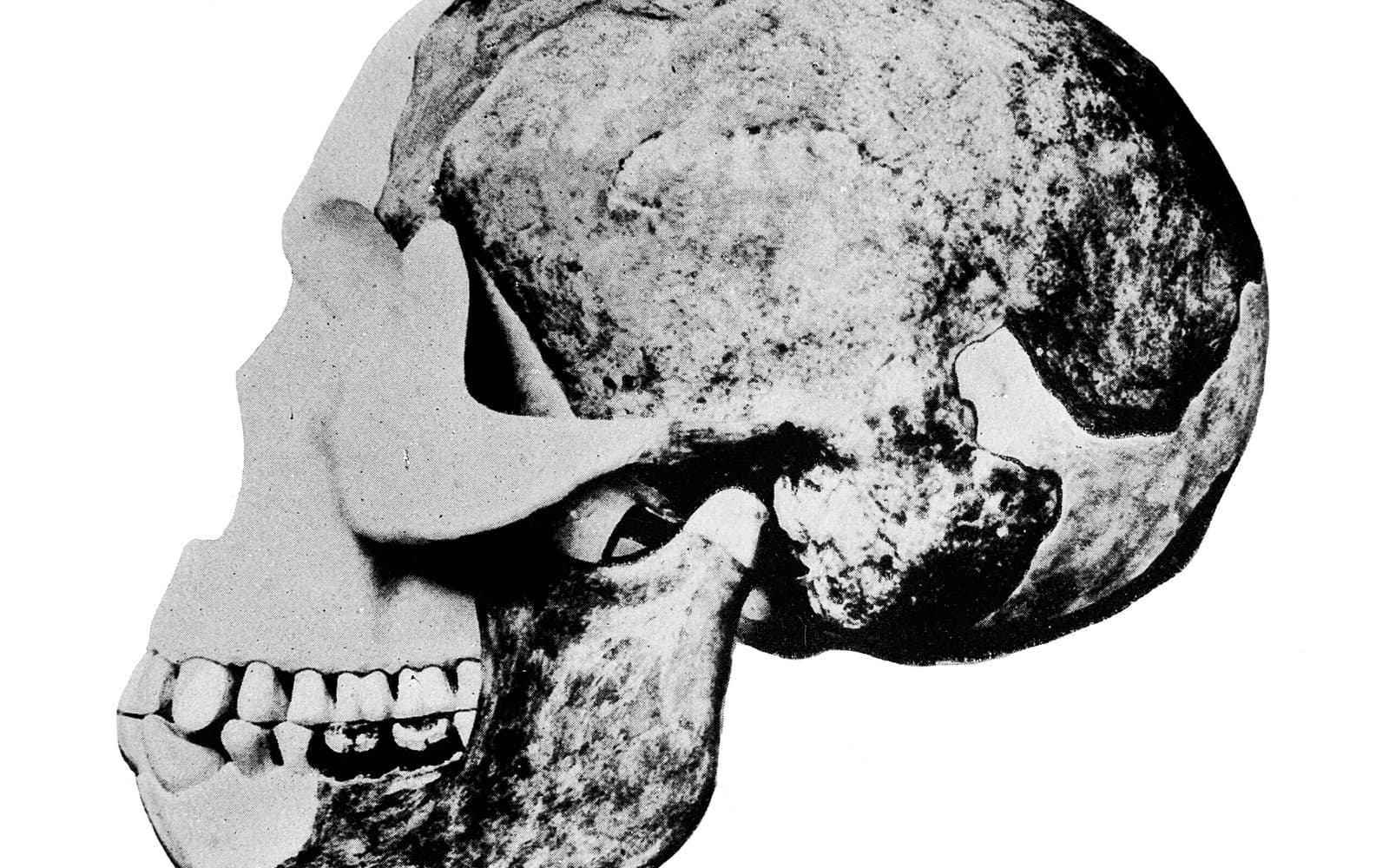
Not everyone was fooled. From 1913 onwards, some anatomists argued that the jaw looked like an ape's, perhaps a chimpanzee's, and could not belong with the skull. But the doubters were outnumbered, and the original bones were mostly kept locked away, so most researchers studied plaster casts.
Charles Dawson died in 1916. After that, nothing significant was ever found at Piltdown again.
Unmasked
Over the following decades, real fossils of early humans were found in Asia and Africa. None of them looked anything like Piltdown Man, which was slowly pushed to the sidelines of human history.
In 1949 Kenneth Oakley of the British Museum (Natural History) used a newly refined chemical test to show that the bones were nowhere near as old as had been claimed. Then, in November 1953, Oakley, Joseph Weiner and Wilfrid Le Gros Clark published the full answer. The jaw and the canine tooth were from a modern ape. The teeth had been filed down to make them look worn like a human's. The jaw had been stained to match the skull, and the canine had been painted.
The scientists who dug at Piltdown, they wrote, "were the victims of a most elaborate and carefully prepared hoax". The faking of the jaw and canine was "so extraordinarily skilful", and the hoax so "entirely unscrupulous and inexplicable", that it had "no parallel in the history of palaeontological discovery". Later work showed that the tools, the animal bones and the cricket bat had been planted too.
Old bones in Parliament
The news caused a sensation. In the House of Commons, a group of MPs tabled a motion of no confidence in the trustees of the British Museum "because of the tardiness of their discovery that the skull of the Piltdown Man is a partial fake".
Few took it seriously, and its lead sponsor soon withdrew his name. The Speaker, himself one of the trustees, replied that they, "like myself, have many other things to do besides examining the authenticity of a lot of old bones".
Who did it?
For decades, people argued about who was behind the hoax. Over the years at least 20 people were accused, including Teilhard de Chardin, a museum volunteer named Martin Hinton, and even Sir Arthur Conan Doyle, the creator of Sherlock Holmes, who lived nearby. None of those cases was ever proved.
In 2016, scientists at the Natural History Museum and elsewhere used DNA testing and scans to examine the remains again. DNA from two of the teeth, together with detailed measurements, showed that the jaw and teeth very likely came from a single orangutan, and the skull pieces from at least two people, possibly medieval. The pieces had all been faked in the same way, down to the same putty and the same Piltdown gravel packed into them. One person, they concluded, was behind it all, and it was "most likely" Charles Dawson.
Whether he worked alone remains uncertain. But his "hunger for acclaim", the researchers wrote, "may have driven him to risk his reputation and misdirect the course of anthropology for decades".
Today the village pub is called The Piltdown Man.
Odd, and entirely British.
More Crime & Mysteries →