A Londoner invented the web, and his boss called it "vague but exciting"
In March 1989 a British software engineer at CERN handed his boss a proposal for keeping track of information. His boss wrote "Vague but exciting…" on it. Four years later, CERN gave the result away: the World Wide Web.
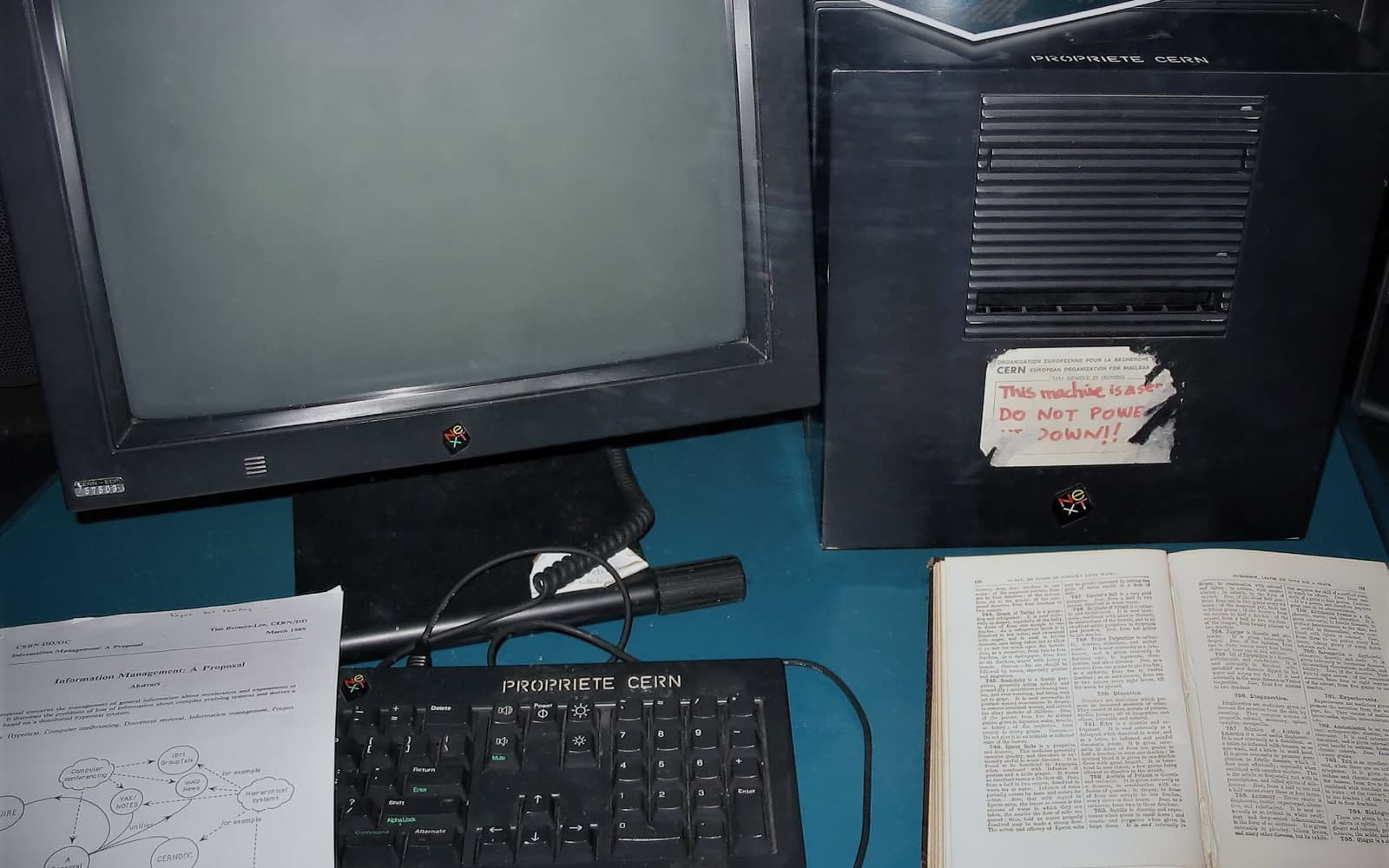
In 2005, in a glass case at CERN, the particle physics laboratory near Geneva, sat a black, cube-shaped computer with a torn label on the front. On it, someone had written in red ink: "This machine is a server. DO NOT POWER IT DOWN!!"
It was good advice. At the end of 1990 that computer was the world's first web server. Its software was written by a Londoner, Tim Berners-Lee, and it all started with a document his boss called vague.
"Information is constantly being lost"
CERN in the 1980s was huge and busy. Scientists came and went, and much of what they knew lived in their heads, on scattered computers or in piles of paper.
In March 1989 Berners-Lee, a software engineer, wrote a paper called "Information Management: A Proposal". "When two years is a typical length of stay, information is constantly being lost," he wrote. "Often, the information has been recorded, it just cannot be found."
His answer was hypertext: documents joined by links, so you could jump from one thing to anything related to it. A "web" of notes with links between them, he argued, "is far more useful than a fixed hierarchical system."
He did not yet call it the World Wide Web. His only name for it then was "Mesh"; he settled on "World Wide Web" while writing the code in 1990.
"Vague but exciting…"
Berners-Lee gave the proposal to his boss, Mike Sendall. Sendall wrote three words on the cover: "Vague but exciting…" Hardly a rave review, but he let Berners-Lee carry on and, in 1990, agreed to buy him a NeXT computer, a powerful workstation made by the company Steve Jobs set up after leaving Apple.
The NeXT arrived in September 1990. In November 1990 Berners-Lee and the Belgian engineer Robert Cailliau put in a formal proposal for a "WorldWideWeb" project. By Christmas, he had worked out the building blocks the web still runs on: HTML for writing pages, HTTP for sending them and URLs for addresses. He also wrote the first browser, called WorldWideWeb, and the first server software.
By December 1990, CERN says, the web was up and running, "albeit between just a couple of computers at CERN".

When did the first website go live?
The first web page was about the web project itself. Berners-Lee has said that its first "http" address, at the end of 1990, was on a machine called nxoc01.cern.ch, which was later given the friendlier name info.cern.ch.
But for months it was really a CERN affair. In March 1991 a simple text-only browser was made available to people using CERN's central computers. The wider world got its first announcement on 6 August 1991, in a post to an internet discussion group about hypertext, and that is the date often given for the web going public.
No copy of the page as it first looked is known to survive. The version CERN put back online in 2013 is based on a copy from 1992.
A Londoner, raised on computers
Berners-Lee was born in London on 8 June 1955, and computers were in the family. His parents were both mathematicians. "They actually met while working on the Ferranti Mark I, the first computer sold commercially," he has said, and as a child he played with five-hole paper tape.
He went to Emanuel School in London and then to the Queen's College, Oxford, where he got a first-class physics degree in 1976. There he built his first computer, using an M6800 processor and, for a display, an old TV and "junk from the Tottenham Court Road".
A 2003 MIT Technology Review column called him "a former student hacker who was once banned from using his university's computer", though the details are hard to pin down.
In 1980 he spent six months at CERN as a consultant and wrote a program for himself to store information and the random connections between things. He named it Enquire, after a Victorian book of advice, *Enquire Within Upon Everything*. It was never published, but it was the seed of the web.
Given away for nothing
On 30 April 1993, CERN issued a statement putting the basic web software into the public domain. Anyone could use it, copy it, change it and build on it, without paying a penny.
Asked later whether he had mixed feelings about not "cashing in", Berners-Lee said: "Not really. It was simply that had the technology been proprietary, and in my total control, it would probably not have taken off. … You can't propose that something be a universal space and at the same time keep control of it."
The web is not the internet
A common mix-up is that Berners-Lee invented the internet. He did not. The internet, which he calls "a network of networks", was already there, built largely on the TCP/IP protocols designed by Vint Cerf and Bob Kahn in the 1970s.
The web runs on top of it. "The Web is an abstract (imaginary) space of information," Berners-Lee explains. He adds: "On the Net, the connections are cables between computers; on the Web, connections are hypertext links."
In a nice twist, when the Queen knighted him in 2004, the honour was "for services to the global development of the Internet".
"This is for everyone"
On 27 July 2012, Sir Tim appeared in the opening ceremony of the London Olympics, sitting at a desk with a NeXT computer in the stadium. He tweeted four words, "This is for everyone", and they were spelled out in lights across the audience's seats. In 2025 he used the same words for the title of his memoir, *This Is for Everyone: The Unfinished Story of the World Wide Web*.
From 2014 CERN lent the NeXT itself, label and all, to the Science Museum in London for several years; the museum says it is no longer on display. For a while, a handwritten sign was all that stood between the World Wide Web and someone looking for a plug socket.
Odd, and entirely British.
More Inventions →