Why British plugs are so big, and why there is a fuse inside every one
The British plug is chunky, three-pronged and painful to tread on. Its size goes back to a wartime committee that planned the wiring of houses that had not been built yet, and decided every plug needed its own fuse.
In June 1942, with Britain at war and many of its cities bombed, a group of electrical engineers sat down to plan something that did not exist yet: the wiring of the houses that would be built once the fighting stopped.
They met 22 times over the next two years, and what came out of those meetings is still in almost every room in Britain. It is why the British plug is the size of a small matchbox, has a fuse inside, and hurts so much when you tread on one in the dark.
A mess of round pins
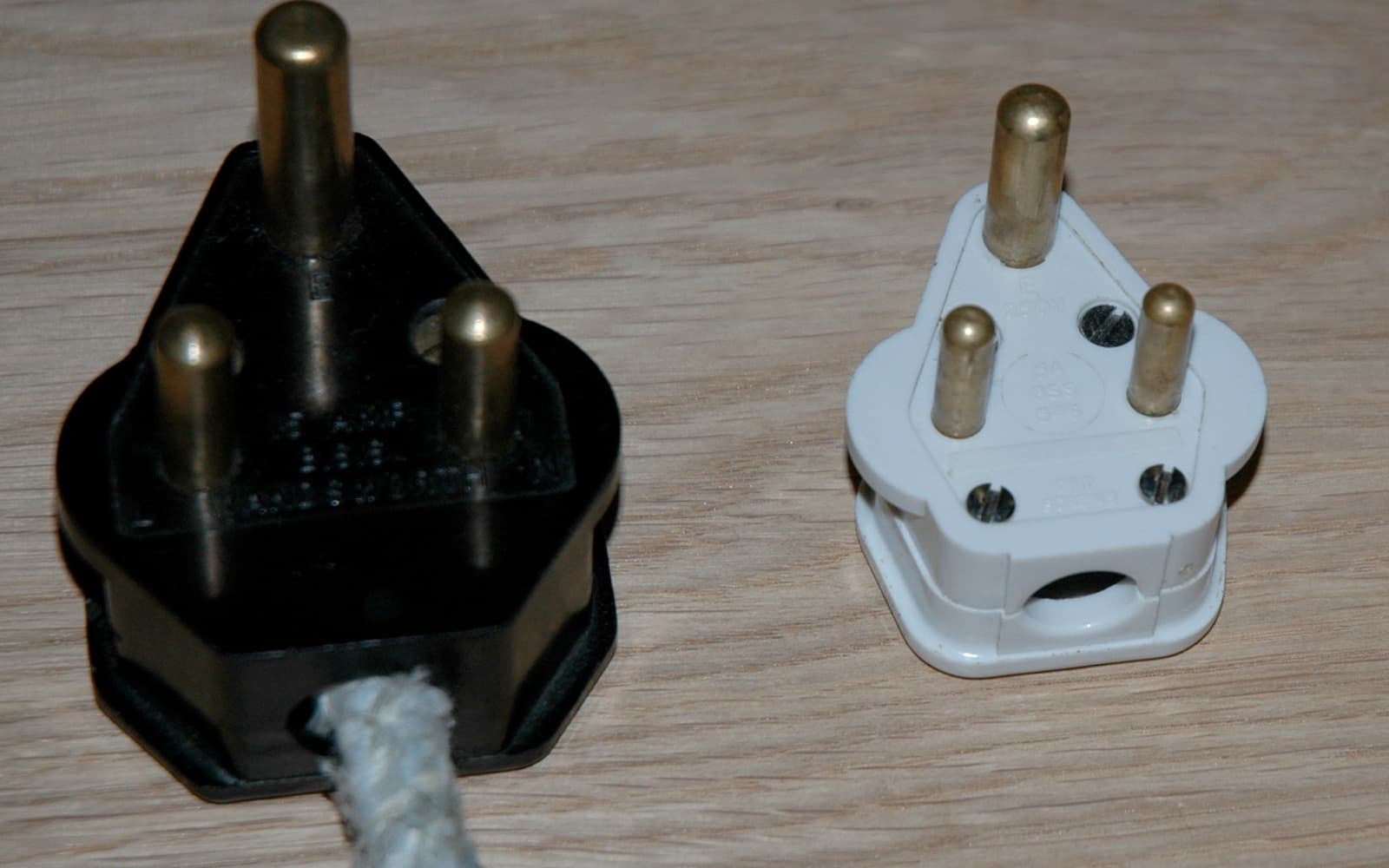
Before the war, plugging things in was a muddle. The standard round-pin plugs of the day, BS 546, came in 2, 5 and 15 amp sizes for the home. Each socket usually had its own fuse at the fuse box, and the plug's size stopped you plugging a heavy appliance into a socket that could not take it.
The engineers' committee, set up by the Institution of Electrical Engineers as part of the government's Post-War Building Studies, called the existing sockets "wholly unsatisfactory from the standpoint of the convenience of the consumer". Many homes had very few sockets, so people relied on adaptors and trailing leads. The gap between 5 and 15 amps, and the cost and bulk of the 15-amp plug, had led people to use non-standard plugs and sockets instead.
A ring around the house
Their answer, Post-War Building Study No. 11, Electrical Installations, came as a main report in January 1944 and a supplement that July. Its big idea was the "ring circuit": a single cable that starts at the fuse box, loops round the sockets in the house, and comes back to where it started.
With power reaching each socket from both directions, one cable and one fuse could feed lots of sockets. The report reckoned a typical small home could be adequately heated by "portable or inset electrical fires or convectors up to 2 kW rating" plugged into it, and there was growing concern over the fast-rising number of small appliances.
There was a catch. The fuse at the fuse box had to be big enough for several sockets in use at once, which made it far too big to protect the thin flex on a table lamp or radio. If that flex developed a fault, the main fuse might never blow, and the flex could overheat.
So the committee put a fuse in every plug.
Why it ended up so big
A fused plug was not the committee's first choice. According to Malcolm Mullins of the plug-maker MK Electric, who wrote a history of the system in 2006, a majority initially favoured a 10-amp fused socket with a round-pin plug to the old BS 546 standard. The final, unanimous decision was for a 3-kilowatt, 13-amp socket, with the fuse in the plug itself.
The report argued that one standard mattered more than personal taste: "the general benefit to be obtained from the widest use of a single standard is so great as to call for the subordination of individual preference".
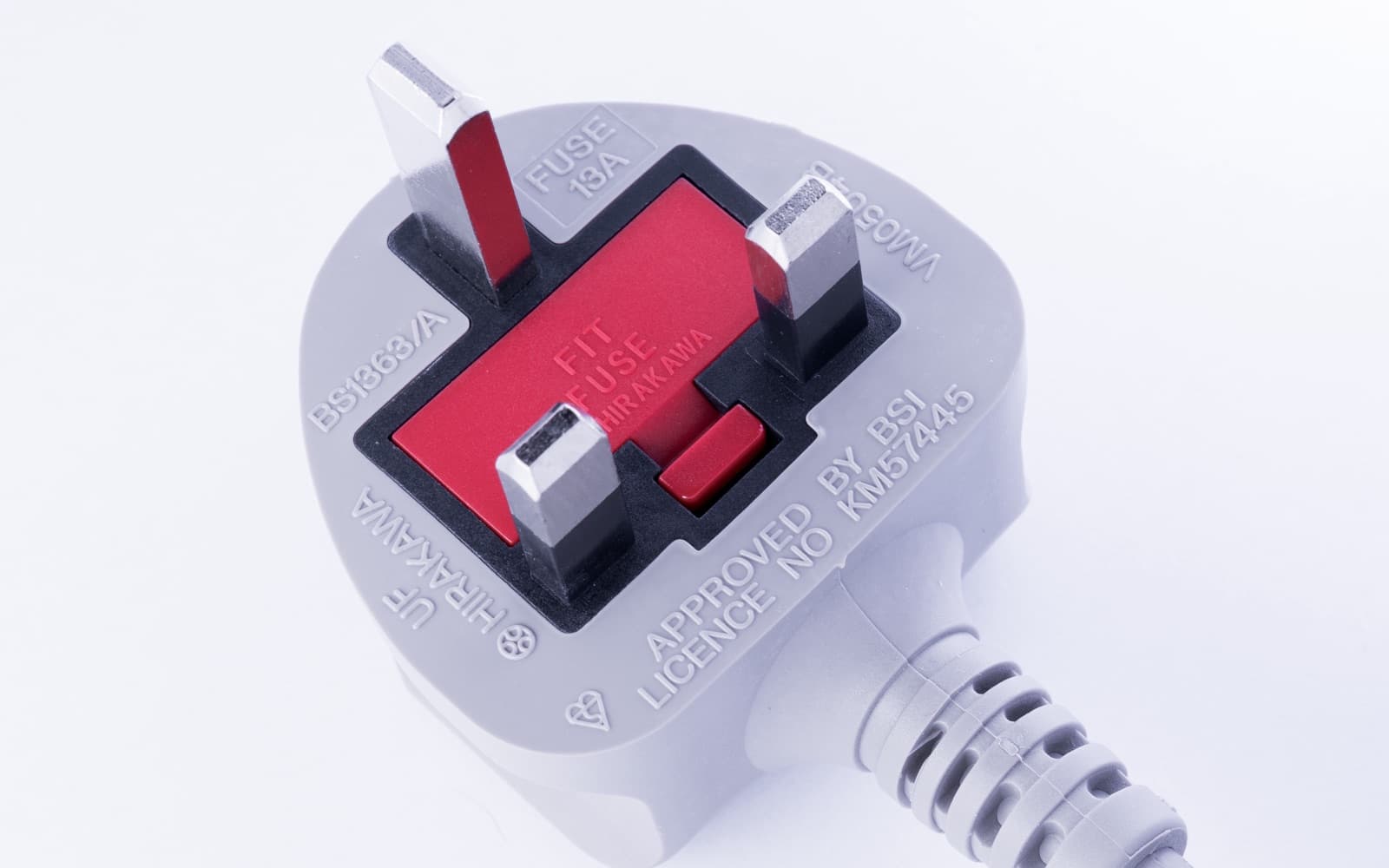
The British Electrical and Allied Manufacturers' Association was invited to propose designs; the Museum of Plugs and Sockets credits the adopted one to MK Electric. In 1947 the new standard, BS 1363, arrived with its three flat rectangular pins.
Much of the plug's bulk comes from what the standard asks it to hold. It needs room for a cartridge fuse about 25 mm long and a grip to hold the cable, which leaves from the bottom rather than the back. The pins must sit at least 9.5 mm from the edge of the plug, which keeps fingers away from them. Add three chunky pins, the earth longest, and it is hard to make small.
Safety mattered too. The 1944 study mentioned children and the need for shutters, so the holes for the live and neutral pins are covered. On many sockets, the longer earth pin at the top pushes the shutters open as the plug goes in.
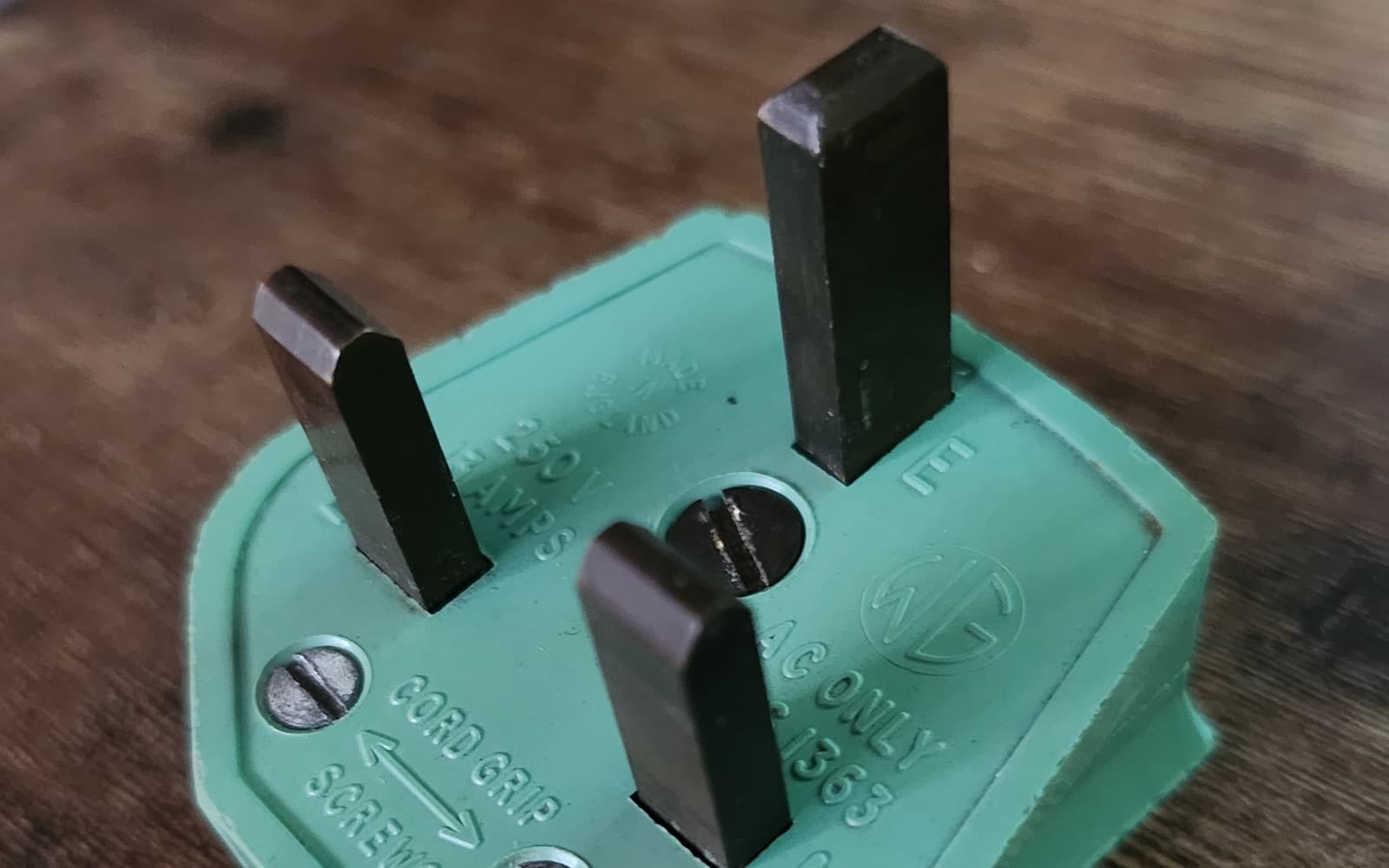
The plug has kept changing. Since 1984, sleeved pins have meant a finger cannot touch live metal on a half-pulled-out plug. And since the mid-1990s, the Plugs and Sockets etc. (Safety) Regulations 1994 have required most household appliances to be sold "correctly fitted with a standard plug". Before then, appliances were often sold without a plug, and buyers wired one on themselves.
Myths about the plug
**The fuse protects your kettle.** It does not. It protects the flexible cable between the plug and the appliance. A Ministry of Works pamphlet from 1957 put it plainly: "The way to ensure adequate and selective protection is to connect each flexible cord to a separately fused plug."
**It was all about a copper shortage.** Sources disagree. The IET's Michael Peace has said ring circuits were conceived "to minimize the amount of copper required", and a 1957 Ministry of Works note claimed a ring used about 30% less cable. But the Museum of Plugs and Sockets argues that "ring wiring was not driven by copper shortage". Mullins's account acknowledges the expected shortage of materials but puts most weight on convenience, safety and the scale of house-building.
**It was designed to be the safest plug in the world.** The committee was after plenty of affordable sockets, not a title, though Mullins himself calls the result "a system that cannot be equalled in terms of safety".
Still everywhere
Rival 13-amp plugs from Wylex and Dorman & Smith lingered for years, and round-pin sockets never fully vanished. But from the late 1940s new homes were wired for BS 1363, and by the end of the 1960s it had become the prevailing standard.
It also travelled: Ireland adopted it, partly to match Northern Ireland, and it is used in many former British territories, from Hong Kong and Singapore to Kenya and Malta.
Pick one up and you are holding a committee's 1944 best guess about life in the houses Britain was about to build.
Odd, and entirely British.
More Oddities →