Why Britain is called Britain, and the Greek explorer who wrote it down first
More than 2,300 years ago, a Greek sailor described a cold island at the edge of the world. Critics called him a liar, but the name he wrote down is the ancestor of the one we still use.
In the late fourth century BC, perhaps around 325 BC, a Greek from the city we now call Marseille sailed north beyond anything his readers knew. He said he had travelled over the whole of a large island in the northern ocean. He said its coastline ran to more than 40,000 stadia, thousands of miles. He said that six days' sail further north lay a place called Thule, near a frozen sea.
His name was Pytheas of Massalia. Three centuries later, the Greek geographer Strabo was still calling him "an arch-falsifier". But Pytheas left behind something that outlived every insult: the oldest known version of the name Britain.
A book that vanished
Pytheas wrote up his journey in a book usually known as On the Ocean. Not a single copy survives. Everything we know about it comes from later writers who read it and quoted it or mocked it.
Strabo passed on the historian Polybius's complaint that Pytheas claimed to have "travelled over the whole of Britain that was accessible". Pliny the Elder, in his Natural History of AD 77, repeated Pytheas's figure for the island's circumference. And the Sicilian historian Diodorus gave a description of Britain that many scholars think draws, directly or through later writers, on Pytheas: an island "triangular in shape, very much as is Sicily", where people near a headland called Belerium, the Land's End area, mined tin and worked it into pieces "the size of knuckle-bones" for traders to carry to the Continent.
Pytheas was not as wild as his critics thought. Britain really is roughly triangular, and the Cornish tin trade was real.
The Pretannic Isles
Diodorus calls the island Prettanike, with a P. Other Greek writers spoke of the Pretannic or Brettanic Isles, and the old manuscripts waver between the two letters. Many scholars think Pytheas wrote it with a P, and that he was passing on a name he heard locally. The people, it seems, were called something like Pritani.
Greek writers were already using a B by the second century BC: the historian Polybius wrote of Britain that way. So by the time the Romans arrived, the P had become a B. Julius Caesar, who landed in 55 and 54 BC, wrote of Britannia and the Britanni, and that is the spelling that stuck in Latin, French and English. Nobody knows for certain why the letter changed.
Painted people?
So what did Pritani mean? This is where hard evidence runs out.
The Welsh name for Britain is Prydain, and it has kept the P. The University of Wales's great historical dictionary, Geiriadur Prifysgol Cymru, traces Prydain back to a reconstructed Brittonic form, *Pritani, and compares the Greek Pretanoi. (Brittonic is the Celtic ancestor of Welsh, Cornish and Breton.) It also lists Prydyn, an old Welsh name for the Picts, and, with a cautious question mark, connects that name to the Welsh word pryd, which means appearance, form, shape or complexion.
That possible link is the basis of the famous theory. If the name comes from a word for "form" or "appearance", perhaps the Pritani were "the people of the designs": people who painted or tattooed their bodies. The idea has been taken up by some scholars, but it remains a theory. It rests on one word root and a handful of Roman descriptions. No ancient Briton ever explained the name.
In his account of the Gallic War (book 5, chapter 14), Caesar wrote, in H. J. Edwards's translation: "All the Britons, indeed, dye themselves with woad, which produces a blue colour, and makes their appearance in battle more terrible." Caesar's Latin word was vitrum, which normally means glass. Translators have long taken it to mean woad, a blue dye plant, but that is debated: a 1991 paper with the Latin title "Non Isatis sed Vitrum" ("not woad but vitrum") argued it could have been a mineral pigment instead.
The Romans later gave the people of the far north their own name: Picti, Latin for "painted ones", which first appears in a speech of AD 297. Whether that was a translation of a native name, or simply a soldiers' nickname, nobody can say.
Albion, the older name
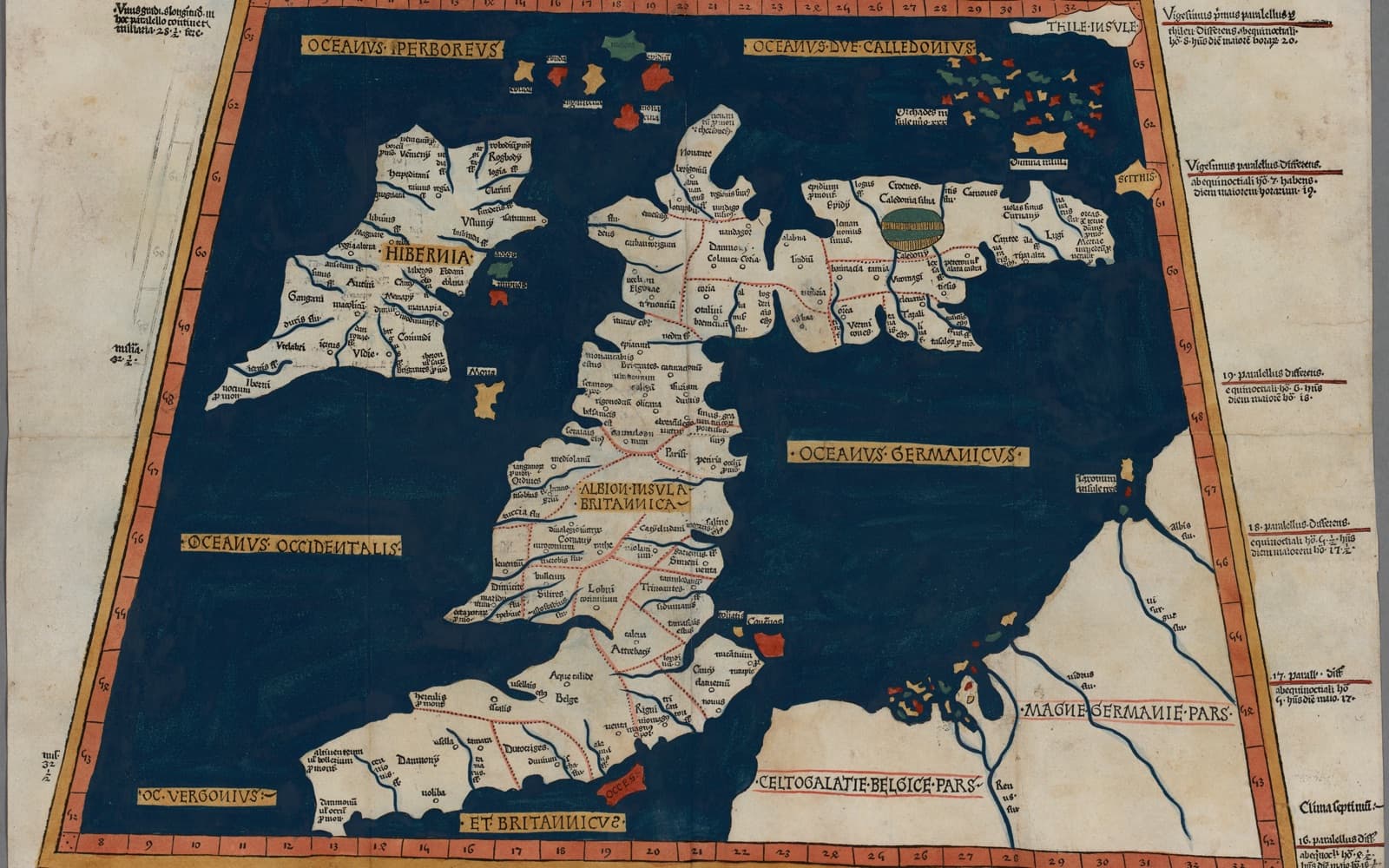
Britain had another name too. Pliny wrote that the island's "former name was Albion". An old Greek treatise On the Universe, credited to Aristotle but probably not by him, names Britain and Ireland as Albion and Ierne. Ptolemy's Geography also calls Great Britain Albion, which is why the map above says "Albion insula Britannica". Albion is often linked to the Latin albus, "white", and to the white cliffs of Dover. Linguists trace it, more cautiously, to a Celtic root that may have meant "white" or possibly "the world".
From Britannia to Great Britain
After the Roman invasion of AD 43, Britannia became the name of a Roman province. Around AD 150, the Greek astronomer Ptolemy wrote of "Great Britain" (megale Brettania) and "Little Britain" (mikra Brettania) in his Almagest. His Little Britain was Ireland.
The phrase came back later for a different reason. After Britons settled in north-western Gaul in the early Middle Ages, that region became Brittany, another Britain. In 1604, James VI of Scotland and I of England proclaimed himself King of Great Britain, but that was a royal title, not law. That came with the union of England and Scotland, which declared that from 1 May 1707 the two kingdoms would be "United into One Kingdom by the Name of Great Britain".
Myths worth binning
The most colourful origin story is Brutus. In about 1136, the cleric Geoffrey of Monmouth wrote a History of the Kings of Britain, in which Brutus, a great-grandson of the Trojan hero Aeneas, lands on an island called Albion, defeats its giants and, in Aaron Thompson's translation, as revised by J. A. Giles in 1842, "called the island after his own name Britain, and his companions Britons". Historians now regard it as legend.
"Britannia" was not a Roman invention, either. The Greeks had the name, with a P, centuries before Caesar. And the "Great" in Great Britain originally meant larger, not grand, as opposed to Little Britain.
The P that Pytheas heard more than 2,300 years ago has not quite disappeared. Every time someone in Wales says Prydain, it is still there.
Odd, and entirely British.
More Words & Language →